
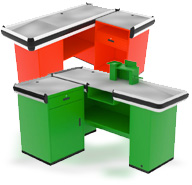
A commercial checkout counter is a special type of retail fixture used at the checkout to process customer transactions. They are used as the main processing point where customers place their chosen items, the cashier scans them and the payment is processed safely. We offer a range of durable counters suitable for the heavy daily use often seen in busy commercial retail environments at Super Market Store Equipment.
Commercial checkout counters are usually used for efficient processing of consumer transactions, and for organizing the scanning, bagging and payment collection process. They’re involved in payments and they’re also important merchandising areas for high-visibility impulse items such as snacks or accessories. The proper setup from Super Market Store Equipment can increase the speed at which your customers move through the store and help you maximize your retail bottom line per square foot.
Supermarket owners, grocery store operators, convenience store managers, and large self-service retail center proprietors should invest in commercial checkout counters. Any retail establishment requiring a centralized, durable, and professional space for finalizing high-volume transactions will benefit from these fixtures. Super Market Store Equipment caters to all business sizes looking to upgrade their checkout efficiency and store layout.
Heavy-duty, industrial-built premium checkout counters that will support 200 to 500kg per section. These include anti-slip work surfaces, scratch-resistant powder-coated or stainless steel finishes, and separate areas for cash drawers, conveyor systems and scanner integration. Supermarket store equipment includes smooth surfaces and a minimum number of joints to prevent dirt and meet high sanitary standards.
Professional counters increase the overall layout optimization of a store. When placed, they improve the flow of traffic and the waiting time of the customers. Structures are ergonomically designed to improve the comfort and productivity of cashiers and reduce fatigue during long shifts. Selecting the best solutions from Super Market Store Equipment also guarantees that all individuals can pay for their purchases and shop independently, thanks to the existence of accessible routes and proper counter heights.
Consider the size of your store, the number of customers you see daily, and the way you choose to run your business to decide on the best model to choose. Decide if you need a compact counter for a space-constrained lane or a large modular conveyor for a fast lane. Always verify the model with your own requirements for functionality, such as POS terminals and scales. There are a variety of store equipment available for Super Markets depending on the workflow.
Non-abrasive cleaners are to be used daily to wipe all counter surfaces to remove any smudges, spills and product residue, except on laminates where ammonia-based formulas should not be used. Checks of moving parts such as drawers and hinges should be done monthly for wear. Regularly inspect internal components and check grounding wires for powered units. Super Market Store Equipment encourages regular upkeep of your equipment to make it last longer.
Always purchase fixtures from a trusted supplier such as Super Market Store Equipment to ensure warranties are valid. Ask for full specification sheets to confirm dimensions, load capacity and material grade before buying. Be sure that the units meet local safety standards and electrical codes, and carefully look at the vendor’s technical support policies to prevent expensive operational downtime in the future.